Getcho Goofass On Chicago Over Everything Shirt
Product Highlights
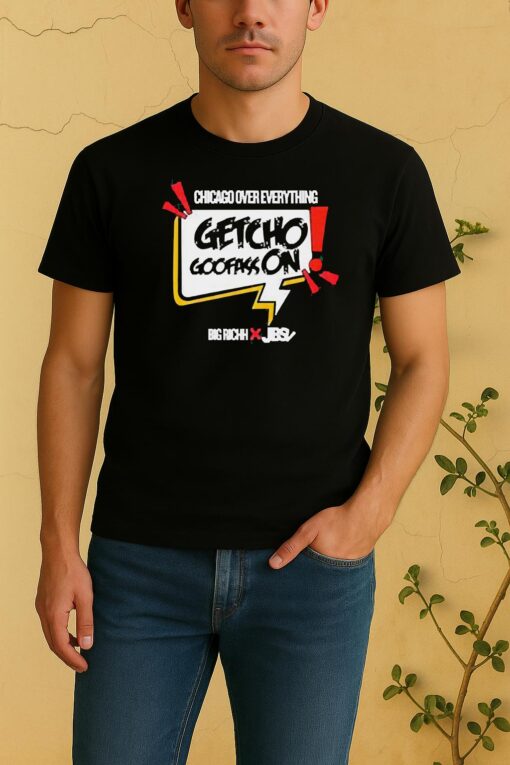
- Premium Quality Materials
- Stylish and Modern Design
- Highly Durable for Daily Use
- Perfect as a Gift or Personal Item
In summary, if you’re looking for a reliable, stylish, and high-quality item, the Getcho Goofass On Chicago Over Everything Shirt is definitely worth considering. Click the link above to learn more!
AG: Guidi’s work seems to oscillate between lyricism and rigour, between abstraction and concreteness. How did you work to preserve this balance in the curatorial construction of the exhibition? AR: I would actually say we worked on it, because everything was shaped through a close, ongoing dialogue with Guido. And I want to thank him here for his extraordinary human openness and intellectual generosity, which were both rare and deeply meaningful to me. The coexistence you speak of—between lyricism and rigour, abstraction and concreteness—is something we find in Guidi’s work with remarkable consistency. It’s a quality that feels both deliberate and spontaneous. Many of his photographs display a particular geometry in the framing, but if you look closely, you realise it’s not a geometry imposed upon reality. Quite the opposite—it’s a geometry revealed by reality itself. Something similar happens with the tension between abstraction and concreteness: some images possess the clarity and purity of abstract composition, yet their “matter” is deeply rooted in the real, such as a toolshed wall, a stretch of asphalt, the metal frame of an empty billboard.Getcho Goofass On Chicago Over Everything Shirt
AG: I was struck by a phrase in the exhibition text: “an image that contains almost nothing.” Can we speak about the role of “emptiness” in Guidi’s work, not as lack, but as a space for openness and suspension? AR: The idea of an empty image sounds like a paradox—and yet, in Guidi’s work, nothingness or near-nothingness often becomes visible. There’s a photograph in the exhibition, taken in Treviso in 1979, that I’d like to use as an example: it’s a black-and-white image of a wall, with a blank sheet of paper taped to it. It could have been taken anywhere, at any time. There are no clues to tell us where we are or when. One almost gets the feeling that this image is waiting to welcome others, as if it were a screen for our imagination, ready to reflect whatever we might project onto it. However, as a photograph, it is also a tangible reminder of something that once existed and no longer does. Thus we find ourselves within this productive contradiction, this perceptual tension: the photograph draws us toward a real that slips away even as it opens a space for our inner world. AG: The artist’s shadow frequently appears in the exhibition, as if the photographic process itself were being made visible, the act of seeing staged. How did this element make you reflect on authorship and the construction of vision?
From:
Bino Shirt